

5F ( 🌱 Farm → 🧵 Fiber → 🏭 Factory → 👗 Fashion → 🌍 Foreign)
PM MITRA
Pradhan Mantri Mega Integrated Textile Region and Apparel





5F ( 🌱 Farm → 🧵 Fiber → 🏭 Factory → 👗 Fashion → 🌍 Foreign)
PM MITRA
Pradhan Mantri Mega Integrated Textile Region and Apparel
5F ( 🌱 Farm → 🧵 Fiber → 🏭 Factory → 👗 Fashion → 🌍 Foreign)
PM MITRA
Pradhan Mantri Mega Integrated Textile Region and Apparel
TOP HIGHLIGHTS
Tamil Nadu PM MITRA park Attracts ₹2,000 Cr Investment

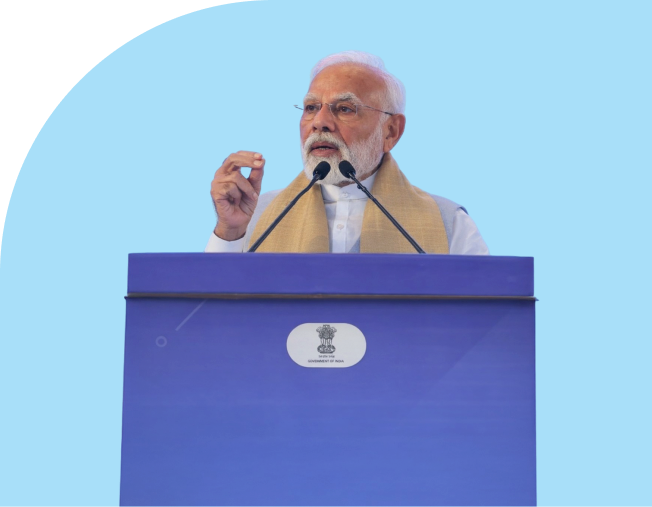
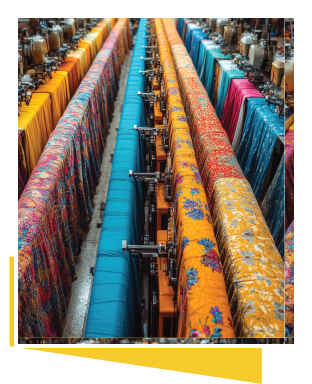
Today’s Bharat is working to take its textile industry to the top of the global market. The country’s goal is to restore the thousands of years of pride in Bharat’s textile sector. PM MITRA Park is another significant step in this direction.


Salient features

7 World Class
Textile Parks

8,699 ₹ 4,445 cr
Total outlay by the Central Government for over a 7 year period up to 2027-28

1 Lakh+
Direct Jobs per park

1 1,000 Acres
Land per Park

Aligned with UNSDG Goal 9: Build resilient infrastructure, promote sustainable industrialization, and foster innovation.
7 PM MITRA Parks
PM MITRA park locations are strategically selected based on their inherent strengths for textile industry growth and strong connectivity linkages. A transparent challenge method used to select the best sites across India.

1052 acres
in Bhainsola (Dhar)

~13 lakh sq. ft.
81 plug-and-play units planned

1289.68 acres

2*30 ton/hr
in Bhainsola (Dhar)

15 MLD CETP + 5 MLD STP
water supply system

110/33/11 kV
Substation
Towards making India’s textile sector
globally competitive
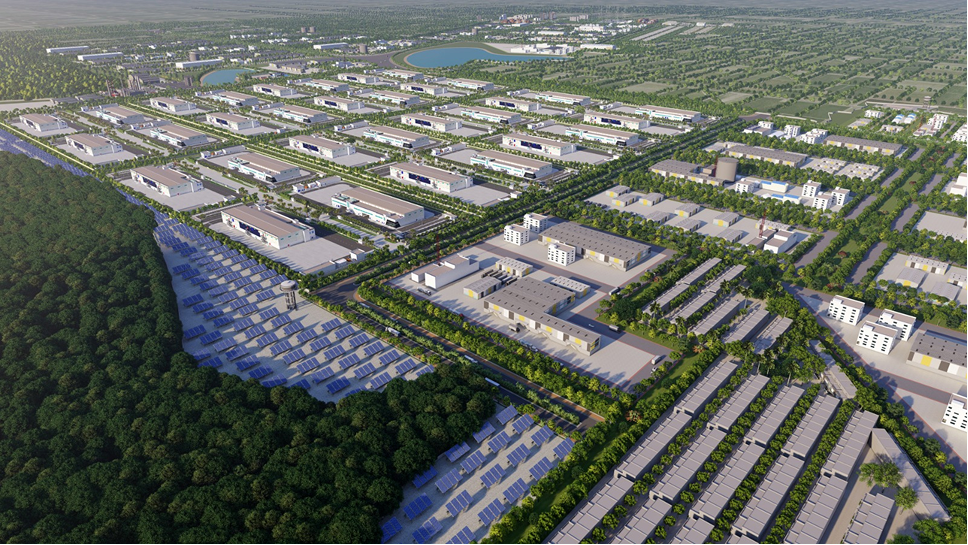
- Creation of a modern & integrated textile value chain at one location to achieve higher size and scale.
- Each park to be integrated, self contained and sustainable.
- Large park size of 1,000 acres to achieve higher scale of operations and economies of scale
- Operation ready infrastructure for anchor and ancillary units.
- Catering to the entire value chain from spinning to RMG
- Facilities for incubation, value addition, and global market access.
Infrastructure
Integrated, world-class infrastructure to support the entire textile value chain
- Power: Substations, feeder connectivity, backup systems and underground cabling ensuring reliable power supply.
- Water: Centralized raw and treated water systems with WTPs, reservoirs and 24×7 supply.
- Road network: Hierarchical internal roads for freight, workforce and emergency services.
- Comprehensive drainage: Flood-resilient stormwater and sewerage systems.
- Robust utility corridors: RCC trenches carrying power, water, gas, steam and data.
- Fire & emergency: Fire stations, response units and first-aid facilities.
- Logistics enablement: Truck parking and loading-unloading bays.
- Skilling institutions: Skill development centres, ITIs and apparel training institutes aligned to textile operations.
- Process utilities: Centralized steam, power and water supplied at regulated or subsidized rates.
- Plug-and-Play units: Ready-built factory sheds with pre-installed utilities for faster commissioning.
- Common testing facilities: In-park textile testing laboratories supporting compliance and export requirements.
- Research & development centres: R&D and Centres of Excellence supporting process and product innovation.
- Design & innovation centres: Facilities for product design, sampling and value addition.
- Administrative & park management infrastructure: Centralized administration enabling single-window facilitation.
- Smart manufacturing: IoT-enabled systems, real-time monitoring, digital backbone and automation readiness.
- SCADA & digital platforms: Centralized monitoring of utilities, CETPs, energy and water usage.
- Integrated command & control: Park-level centres for utilities, safety, security and environmental monitoring.
- Security & surveillance systems: Controlled access, CCTV surveillance and coordinated emergency response.
- Worker housing: Purpose-built hostels and residential facilities with dining and recreation amenities.
- Schools & childcare: Schools, play schools and crèches supporting workforce families.
- Healthcare: Medical centres, clinics and hospitals providing primary and emergency care.
- Daily-use amenities: Canteens, food courts, retail spaces, sanitation blocks and guest facilities.
- Zero Liquid Discharge (ZLD) & advanced STP/CETP: Centralized CETPs ensuring near-total wastewater recycling.
- Systems on world class MBR facility with ME.
- Green cover: Landscaped buffers, open spaces and green belts integrated across the park.
- Green power usage: Solar power systems including rooftop installation- integration of renewable energy sources.
- Water conservation: Rainwater harvesting, treated water reuse and stormwater integration.
- Waste management: Solid and organic waste management with recycling systems.
- Disaster-resilient infrastructure: Climate-resilient utilities and logistics infrastructure.
- Sustainable Infrastructure: in terms of at least 12-15% of the project area designated for green spaces, including Open Space Reservation (OSR) and a peripheral tree cover.
- Global sustainability benchmarking: LEED-aligned green buildings and energy-efficient systems.
- ESG compliance: Embedded environmental, social and governance standards in park development and operations.
Park progress to date
Status of implementation so far across all PM MITRA industrial parks in India
 Land Acquisition
 Environmental Clearance
 MoUs Signed and JVs formed
 DPRs Prepared / Approved
 External Infrastructure Works
Internal Infrastructure Works
Investment Interest and employment generation
Land allotment
Park Execution
Park Completion
External Infrastructure Works
Internal Infrastructure Works
Investment Interest and employment generation
Land allotment
Park Execution
Park Completion
What makes PM MITRA Parks unique
PM MITRA Parks bring together India’s vision with world class infrastructure, global benchmarking, and strong sustainability and social standards—creating integrated, future ready textile ecosystems that boost competitiveness and position India as a global textile leader.
PM MITRA parks will

Make India in textiles
globally competitive

Target $250B market
size by 2030

Benefit across the entire
textile ecosystem

Align with UN Sustainable
Development Goals
Unique Intervention
- Integrated Textiles Value Chain right from spinning, weaving, processing, and printing to garment manufacturing, accessories making at one location.
Potential Impact
- End-to-end textile value chain: spinning, weaving, processing, apparel manufacture, and export all co-located, greatly reducing costs and lead times, boosting competitiveness and improving time to market.

Unique Intervention
- PM MITRA Parks run under Special Purpose Vehicles (SPVs) with joint Central–State ownership and dedicated Program Management Agencies
- Implementation via Special Purpose Vehicles (SPVs) under the Companies Act – jointly owned by Central and State governments ensures professional management, high transparency, and synergy between all levels of government
- Actual execution via State Industrial Development Corporations in EPC Mode or via PPP based Master Developer Mode with Parks being developed in DBFOT mode with RFP/DCA tendering aligned to state/regulation best practices.
Potential Impact
- Integrated governance structure ensures better coordination and resolution of both federal and local issues as well as financial support from both central and state polices. The combined support from both central and state governments leads to effective and faster implementation and better resolution of local issues.
Unique Intervention
- Professional implementation agencies (NICDC, PPP Master Developers, State Agencies) and strong RFP/tender frameworks ensures only “A-grade” developers and partners implement the parks.
- Technical vetting and benchmarking with best –in-class global Parks and knowledge organizations like ADB and UNIDO for sustainable park practices and global competitiveness.
Potential Impact
Unique Intervention
- Development Capital Support(DCS) from center to states for front loading of infrastructure. [30% of the total project cost upto Rs. 500 crore for Greenfield Park and Rs. 200 crore for Brownfield Park]
- Competitive Incentive Support (CIS) of upto Rs. 300 crore per park as an incentive to manufacturing units to set up early in the park.
- Production linked incentives for technical textile sector.
- Additional incentives for technology adoption, gap funding to ensure viability, and dedicated capital for social and green infra.
- Convergence with other government schemes for MSMEs, skilling, start-ups and so on.
Potential Impact
- Plethora of incentives offered by centre and states can potentially boost investments and attract FDI in textile & apparel sector.
Unique Intervention
- Best practices in industrial land allotment integrated in the land allotment policies
Potential Impact
- PM MITRA park specific industrial land allotment policies developed to prevent land arbitrage while ensuring speedy operationalization, adherence to norms and standards and clear application processes for investors.
Unique Intervention
- Integrated Textiles Value Chain right from spinning, weaving, processing, and printing to garment manufacturing, accessories making at one location.
Potential Impact
- End-to-end textile value chain: spinning, weaving, processing, apparel manufacture, and export all co-located, greatly reducing costs and lead times, boosting competitiveness and improving time to market.
Unique Intervention
- PM MITRA Parks run under Special Purpose Vehicles (SPVs) with joint Central–State ownership and dedicated Program Management Agencies
- Implementation via Special Purpose Vehicles (SPVs) under the Companies Act – jointly owned by Central and State governments ensures professional management, high transparency, and synergy between all levels of government
- Actual execution via State Industrial Development Corporations in EPC Mode or via PPP based Master Developer Mode with Parks being developed in DBFOT mode with RFP/DCA tendering aligned to state/regulation best practices.
Potential Impact
- Integrated governance structure ensures better coordination and resolution of both federal and local issues as well as financial support from both central and state polices. The combined support from both central and state governments leads to effective and faster implementation and better resolution of local issues.
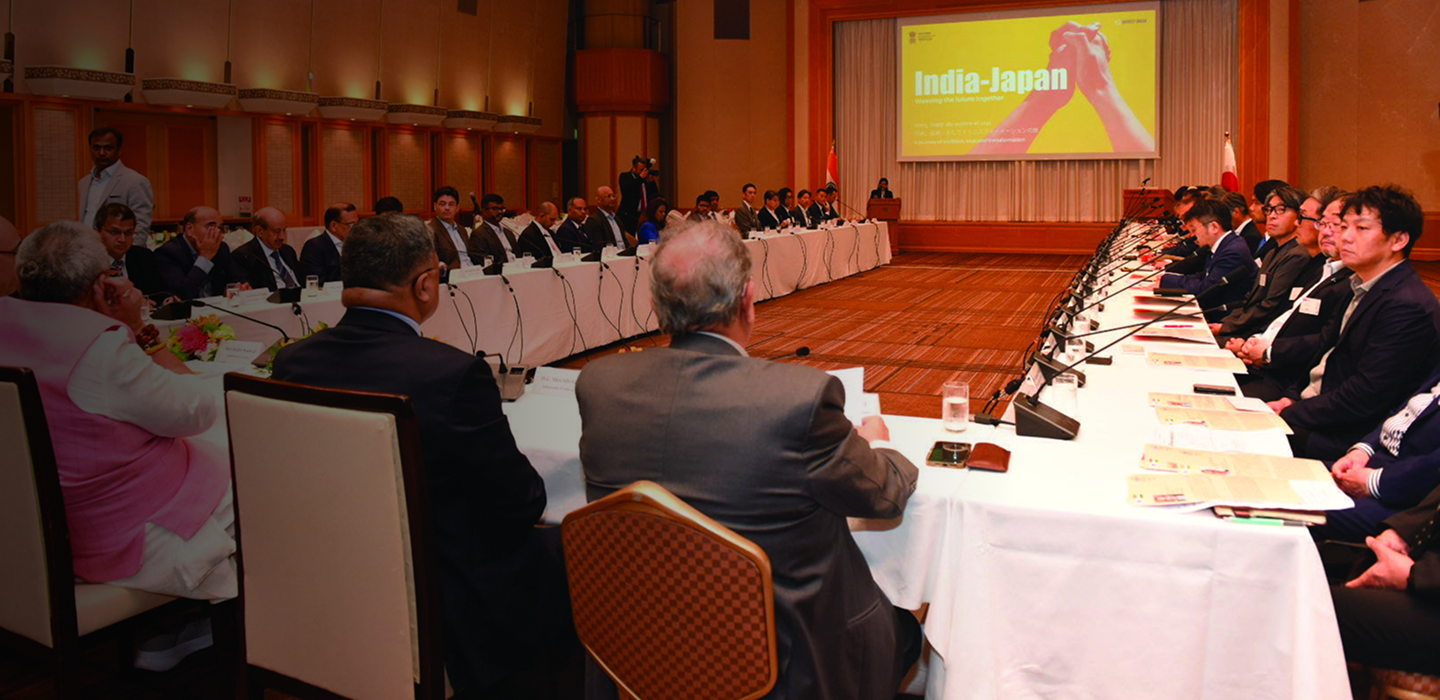
Stakeholder presence
A strong ecosystem of public and private stakeholders







Invest now
Choose the Right Investment Location Across Growth-Ready Industrial Parks
News & Updates

Work on the PM Mitra Park project in Lucknow is progressing rapidly.
Read More →
Nodal panel to speed up amt textile park phase 2
Read More →
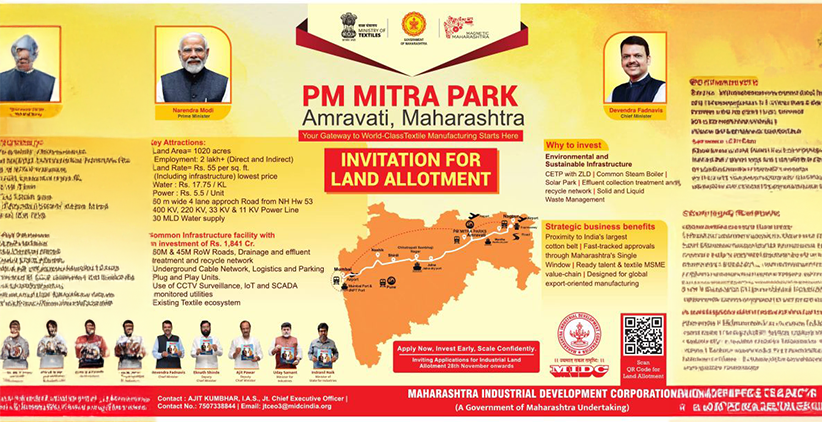
Maharashtra CM Eknath Shinde inaugurates PM MITRA Park in Amravati
Read More →
Centre Clears Rs 1894 Cr. PM MITRA Park For Tamil Nadu
Read More →For any queries connect with us
Reach out to us for information, support and assistance
 Stakeholders Connect