India - A Global Textile Hub
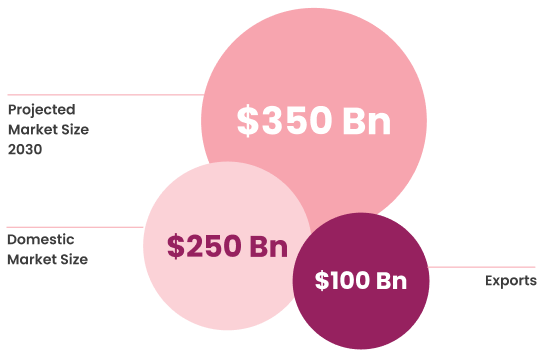
India has a textile and apparel market of USD 176 billion, comprising USD 139 billion domestic demand and USD 37 billion exports, with a vision to scale to USD 350 billion by 2030. India’s textile sector stands at a pivotal juncture. As one of the world’s most dynamic fibre-to-fashion industries, it plays a vital role in driving economic growth and supporting millions of livelihoods.
India is the 6th largest exporter of textiles and apparel in the world, with a 4.5% share in global trade and 8.21% contribution to total exports (2023–24). The sector provides direct employment to around 45 million people and supports over 100 million livelihoods indirectly, including a large number of women and rural population.
Largest Producer of Silk, Cotton and Viscose
2.3%
Contribution of Textiles to India's GDP
Largest Exporter of Textiles
4.5%
India’s Share in Global Textile and Apparel Trade
Women Workforce
45 Mn
Largest Employer After Agriculture
From Union and State Governments (which belongs to the 'PPS' label)
Proactive Policy Support
India’s Current Textile and Apparel Market
$139 Bn Domestic Market | $37 Bn Exports
India’s Diversified Value Chain
India’s strength lies in its ‘farm-to-fashion’ value chain and diversified manufacturing base. India is among the largest producers of silk, cotton and viscose globally and offers a complete value chain spanning spinning, weaving, knitting, processing, and garmenting.
Key textile clusters across states such as Gujarat, Tamil Nadu, Maharashtra, Punjab, and Rajasthan support both domestic and export-oriented production. The sector has alignment with Government’s key initiatives of Make in India, Skill India, Women Empowerment and Rural Youth Employment.
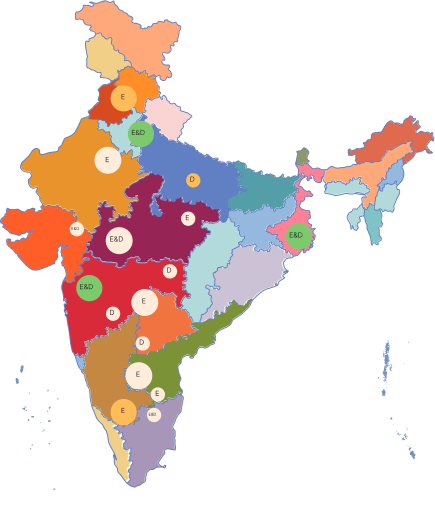
E - Exports D - Domestic
India’s Strategic Vision
India offers a USD 100 billion investment opportunity across segments including garmenting (USD 24 bn), technical textiles (USD 17 bn), MMF (USD 16 bn), and processing (USD 17 bn).' The infographic icons below show: Garmenting $24 Bn, Spinning $17 Bn, Technical $17 Bn, Processing $16 Bn, MMF $11 Bn. The text says 'MMF $16 Bn / Processing $17 Bn' but the icons show 'Processing $16 Bn / MMF $11 Bn
Garmenting

Spinning

Technical

Processing

MMF

Weaving

Knitting

Made-ups

Policy Ecosystem
India’s textile sector is supported by a comprehensive policy ecosystem enabling scale, integration, and global competitiveness A coordinated set of central policies and schemes supports the entire textile value chain, from infrastructure creation and manufacturing scale to skilling, sustainability, and traditional sectors. Together, these interventions create a future-ready ecosystem that strengthens investment attractiveness, drives industrial growth, and enables inclusive development.
Central Government Schemes / Policies Relevant to PM MITRA Parks
A Supportive
Policy Ecosystem
An Open, Predictable and Stable Policy and Regulatory Process
100% Foreign Direct Investment (FDI) is permitted in the textile sector through the automatic route
Samarth Scheme
A placement oriented, industry driven skilling program to build capacity and address skill gaps across the textile value chain. In addition, various States have their own skilling/training support schemes too.
National Technical Textiles Mission
Promoting Technical Textiles towards USD 300 Bn by 2047, A National Mission to support and promote Research and Innovation, Education, Skilling and Market Development in Technical Textiles
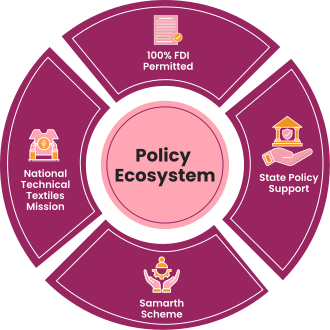


Policy Support, Incentives National by the States
Liberal policy support and generous incentives by State Governments including capital support, wage and skilling incentives, power and water subsidies
Production Linked Incentive (PLI) Scheme
Boosting manufacturing of MMF Fabrics, Apparel and Technical Textiles PLI Scheme with approved incentives of ₹10,683 Cr. (~USD 1 Bn) to promote production of Man-Made Fibre (MMF) Apparel, Man-Made Fibre (MMF) Fabrics and Technical Textiles products.