



सिंहावलोकन

Industrial parks enable scale-driven growth but require integrated sustainability to remain competitive and resilient.
Industrial parks are strategically developed zones that drive manufacturing, exports, and employment by enabling efficiency through co-location, shared infrastructure, and streamlined operations. This concentration creates opportunities for shared sustainability interventions such as centralized wastewater treatment, renewable energy, and industrial symbiosis.

At the same time, parks are among the most resource-intensive operations, with high water, energy, and material consumption, alongside emissions and waste challenges. With rising regulatory pressures, ESG expectations, and global climate commitments, structured sustainability frameworks are essential for long-term viability and competitiveness.

Indian industrial parks have historically faced challenges such as high fossil fuel dependence, inefficient water use, inadequate waste treatment, and weak environmental monitoring. These gaps create operational risks, regulatory non-compliance, and reduced investor attractiveness.

As global supply chains demand sustainable production and financial markets integrate ESG criteria, parks that do not evolve risk losing competitiveness and market access.

The textile sector involves processes that make some units fall into polluting category. Existing frameworks of sustainability, while elaborate, are not specific to the textile sector. Therefore, a structured framework is being built to enable PM MITRA parks to develop their own roadmaps and institutionalize sustainability interventions and their monitoring.

The objective of PM MITRA sustainability framework provides guidance for developers, operators, and policymakers across planning, design, and operations. It integrates environmental and social considerations with infrastructure planning, governance mechanisms, and performance measurement systems. It incorporates global benchmarks and practical interventions such as renewable energy, wastewater reuse, and smart monitoring systems. The framework also builds a strong business case by leveraging shared infrastructure to reduce costs and attract investment.

The framework enables phased implementation and continuous improvement through data-driven decision-making. It provides a structured roadmap across assessment, planning, implementation, and continuous improvement, allowing stakeholders to prioritize interventions and align investments. This ensures sustainability is implemented in a phased and scalable manner.

With defined metrics and monitoring systems, the framework supports performance tracking, stakeholder engagement, and risk management. It also enables access to financing models such as PPPs and green bonds, strengthening long-term viability.

आर्थिक प्रदर्शन

Plant Growth
  • A strong economic ecosystem required for meaningful employment, empowering local enterprises, and driving sustained value creation.
  • This is complemented by the promotion of local businesses and SMEs, supported through supply-chain integration, enhanced opportunities for local procurement, and stronger linkages with regional industries.
  • These efforts collectively contribute to economic value creation, enabling higher revenue generation, improving operational efficiency, and enhancing overall competitiveness.
  • The framework ensures inclusive growth and long-term prosperity for the surrounding community and industry stakeholders.

ढांचा और निरीक्षण

एक अत्यधिक दृढ़ ढांचा, जो स्थायी ढांचा निर्माण के साथ वास्तविक समय के मॉनिटरिंग और सुपुर्दगी प्रणालियों को एकत्रित करता है।

  • Internal infrastructure ensures efficient, resilient, and low-impact operations.
  • Ready-Built and plug-and-play spaces further support sustainable development by minimizing construction waste and enabling rapid, efficient occupancy.
  • Complementing this, smart monitoring enables continuous oversight of environmental, social, and infrastructure-performance indicators.
  • By leveraging real-time data to track energy use, water efficiency, waste generation, and post-operational economic impact.
Infrastructure Illustration

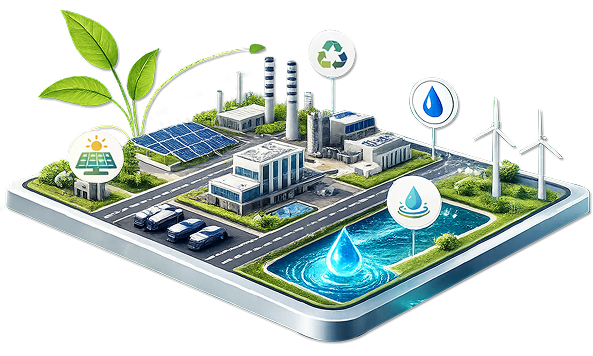
The framework is structured across four pillars enabling a comprehensive and measurable sustainability approach- Environment & Climate Resilience, Infrastructure & Monitoring, Social Measures, and Economic Impact. Each pillar defines objectives, enabling technologies, and performance indicators across environmental, operational, social, and economic dimensions.

These pillars collectively address resource efficiency, infrastructure reliability, worker welfare, and economic outcomes. Integration of digital systems, circular resource use, and shared utilities ensures sustainability is embedded into both planning and operations.

आर्थिक प्रदर्शन

क्षेत्रीय आर्थिक वृद्धि को मजबूत करना निवेश, रोजगार और कौशल के माध्यम से

Solar Panels

रोजगार का निर्माण

नौकरी का निर्माण और कौशल विकास

स्थानीय व्यवसाय और छोटे उद्यमों का प्रचार

आपूर्ति श्रृंखला एकीकरण और स्थानीय खरीदारी

आर्थिक मूल्य निर्माण

राजस्व उत्पादन और प्रतिस्पर्धात्मकता में सुधार

Local Business Factory

बुनियादी ढांचा और निरीक्षण

विश्व-श्रेष्ठ बुनियादी ढांचा विकास की गारंटी, जो स्पष्ट निरीक्षण और सुपुर्दगी यंत्रों के द्वारा समर्थित है।

Infrastructure Image Infrastructure Image
स्मार्ट मॉनिटरिंग
पर्यावरणीय और सामाजिक संकेतकों, अवसंरचना प्रदर्शन तथा आर्थिक प्रभाव संकेतकों (संचालन के बाद) का व्यवस्थित ट्रैकिंग।
आंतरिक बुनियादी ढांचा
किरायेदारों के लिए निर्बाध बिजली आपूर्ति, पूरी तरह से पक्की सभी मौसमों में उपयोग योग्य आंतरिक सड़कें, पैदल यात्री मार्ग, अच्छी तरह स्थापित बाहरी कनेक्टिविटी, तथा RBF या प्लग-एंड-प्ले स्थान।